Discord’s new age verification mandate asks 200+ million users to hand over biometric data or government ID… just four months after leaking 70,000 government IDs.
—
I am not a Discord power user. I use this chat platform solely for notifications triggered by failed or completed task runners, and accessing support staff for software that only offers Discord-based support. Not gaming, not video chat, no community hanging out.
And now Discord wants my face… or does it?
On February 9, 2026 -timed for Safer Internet Day, naturally- Discord announced that starting in early March, every account on the platform gets locked into a “teen-by-default” experience. This will apply to every account, new and existing, unless you verify your age through a video selfie or a government-issued ID scan.
I have a problem with this. Several problems, actually.
> The real risk isn’t that Discord will mishandle your data — though they already have. It’s that facial age verification infrastructure, once built, becomes a tool for censorship and reprisal against first amendment-protected undesirable speech.
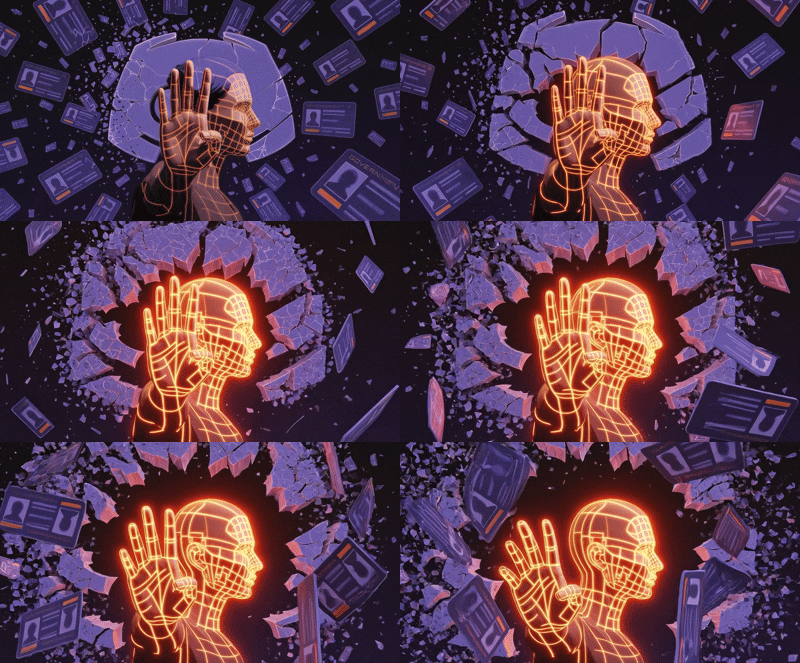
What’s Happening?
Starting in early March 2026, Discord will shift every user account to a restricted “teen-appropriate” mode. Without verification, you lose access to age-restricted servers and channels, the ability to unblur sensitive or graphic content, stage speaking privileges, and full control over DM and friend request settings. Even private group chats get content filtering applied.
Sounds like great protections for children, don’t they?
To unlock your account, you either submit a video selfie for on-device facial age estimation, or scan your government-issued ID and send it to Discord’s third-party vendor partners. Discord also mentions an “age inference model” running in the background that analyzes your account metadata — tenure, device data, activity patterns — to guess whether you’re an adult without requiring active verification.
The phrase “in most cases” appears repeatedly in Discord’s privacy assurances. It’s doing a lot of heavy lifting.
Discord’s Excuses
Discord frames this as teen safety. The listed motivations: compliance with the UK’s Online Safety Act and Australia’s social media age legislation, growing international pressure from lawmakers (Discord CEO Jason Citron testified before the US Senate on child safety in 2024), and creating age-appropriate default protections for users over the age of 13.
The timing, however, makes this sudden demand suspect: reports from early January 2026 indicated Discord had confidentially filed for an IPO. This smells like liability management dressed up as child protection.
Their head of product policy reportedly acknowledged the odds of users leaving, saying “we’ll find other ways to bring users back.” That tells you where the calculation sits.
A Proven Security Problem
October 2025: Discord Wants You to Forget the Breach
Four months before this global rollout announcement, Discord disclosed that a third-party vendor used for customer service and age-verification appeals was breached. Approximately 70,000 users had government-ID photos exposed. The attackers, claimed to have stolen an estimated 8.4 million support tickets and over 520,000 age-verification tickets.
Discord refused to pay the ransom. Their vendor denied responsibility. The IDs that were leaked belonged to users in the UK and Australia, where age verification was already live, the exact same kind of data Discord is now asking the rest of the world to provide.
Oof.
The Ongoing Risks
Third-party vendor exposure. Discord says IDs are “deleted quickly — in most cases, immediately after age confirmation.” That requires trust that the promise of deletion will prevail over corporate greed and lethargy. Furthermore, any human-in-the-loop appeal process — for users incorrectly flagged as teens — recreates the exact vulnerability that was exploited in October. That appeal flow was precisely what generated the data stolen in the breach.
Irrevocable data. Unlike passwords, you can’t rotate your face or your government-issued ID. If this data is compromised, the damage is permanent. Don’t gamble what you cannot ever replace.
The “trust me” problem. Discord claims facial age estimation happens entirely on-device. There’s no independent audit confirming this. The technology itself — estimating age from facial features — is biometric analysis regardless of whether the raw video is transmitted.
Background surveillance. The “age inference model” analyzing account metadata, device data, and behavioral patterns is a passive surveillance system running on every account, verified or not. Put this way, it just sounds dirty.
Circumvention history. When the UK rollout launched, users bypassed facial age estimation using video game character creators — Death Stranding’s character creator was enough to pass the check. Discord says they patched it within a week. With AI generation tools on the horizon, what do the next workarounds look like?

My Problem: “Teen-Appropriate” Is a Censorship Lever
Here’s where the conversation gets interesting — and where I diverge from the typical privacy critique.
I’m not principally opposed to age-appropriate protections for children. I’m a parent. I run self-hosted AdGuard Home on my network. I never offer my children internet-connected devices. I take this seriously.
I fully support it when software developers offer parents better tools to reduce risks for their connected children.
What I’m cautious about is when Discord (or any platform) being the arbiter of what “teen-appropriate” means, and then using facial verification infrastructure to enforce that boundary.
“Teen-appropriate” is a category that sounds neutral. It should be straightforward to define what fits in the restricted bucket. The role, of course, falls directly on Discord in this case, and Discord’s content moderation track record (as with every major platform’s) shows that these categories inevitably drift from “protecting children from explicit content” toward “restricting content that doesn’t align with the current thing.”
Political speech gets flagged. Dissenting opinions get categorized as “sensitive.” Servers discussing topics that make advertisers uncomfortable get age-gated. And once you’ve verified your identity with a face scan or government ID, you’re no longer anonymous. Your real identity is tied to your speech, and in a polarized system, this exposure often leads to self-censorship based on the prevailing political party.
To add, facial age verification infrastructure, once built, becomes a tool for censorship and reprisal against first amendment speech. The same system that checks whether you’re 18 can check whether you’re the person who posted in that server, said that thing, or joined that community. The infrastructure doesn’t care about the stated intention. We are seeing this with reddit, where the Liberal-majority of moderators impose one-sided moderation policies, remove dissenting content at will, or shadow-close comments or outright insta-ban anyone who also participates in the wrong team’s subreddit.
Verification could be tolerable… maybe… if we trusted Discord not to abuse it. But trust is earned, not declared in a press release. And Discord hasn’t earned it. Not after the October breach. Not while filing for an IPO. Not while building background inference models that analyze your behavior whether you consent or not.
That the Internet Is Dangerous is a Parenting Problem.
The internet, much like the world at large, is full of risks to a child. Predators, graphic content, manipulation, addiction: all of these are real threats with horrible consequences. I don’t minimize them.
The solution isn’t handing a corporation the keys to identity verification for every user on the platform. The solution is parents being aware of what their children are doing online and having the tools to protect their children’s digital interactions at the network and device level.
I personally handle this by running AdGuard Home as a self-hosted DNS filter on my network. It blocks ads, trackers, and entire content categories before they reach any device in my house. I never give my children internet-connected devices — no tablets, no phones, no unsupervised access. That’s a deliberate and admittedly extreme choice that we make in the face of extreme dangers, and it’s one every parent can make which spares offering their face to Discord.
The honest caveat: not every parent has the technical ability to self-host a DNS filter. I get that. But the answer is better parental tools — not platform-level biometric gatekeeping that treats every adult user as a suspect until they prove otherwise. Router-level parental controls, DNS filtering services like NextDNS (no self-hosting required), and device-level restrictions already exist. They put control in the parents’ hands, where it belongs.

What I’m Doing Instead
n8n Notifications
This is the easiest migration. So easy, I haven’t decided yet. n8n has native nodes for multiple notification platforms, and swapping out a Discord webhook will be a weekend project at most.
Telegram is my first pick. Lightweight, fast, free, and excellent for personal notification bots. Creating a Telegram bot takes minutes, n8n has a native node, and no identity verification is required beyond a phone number. For pure automation notifications — task failed, task completed, error logged — Telegram may be actually better suited than Discord ever was.
Other options worth knowing about: Pushover ($5 one-time, purpose-built for push notifications), Mattermost (self-hosted, open-source Slack alternative), and Ntfy (open-source, self-hostable, simple HTTP API). Email works too — n8n can send Gmail/SMTP notifications directly.
Let me know if you have any other ideas.
Software Customer Support
This one is harder because you’re dependent on the vendor’s choice. It’s become a more common practice for a company to gate its only support channel to chat platform, but now it’s behind a platform that might require biometric verification or government ID. That’s worth raising directly with the vendor. Many companies that use Discord for community support also maintain email or ticketing systems — they just don’t advertise them.
If Discord is truly the only option, push back. A vendor that forces its customers through biometric gatekeeping for support access should hear from customers who find that unacceptable.
Gaming Chat, Voice, and Video Calls
For the gaming crowd: Mumble is open-source, self-hostable, low-latency voice chat originally built for gaming. Element/Matrix is decentralized, end-to-end encrypted, and self-hostable with voice and video support. Steam Chat has improved significantly and doesn’t require a separate platform. TeamSpeak (flash from the past) has been doing self-hosted gaming voice chat for decades.
My Current Assessment
Discord’s move is the most aggressive age verification deployment by a major social platform that we’ve seen yet. They’re asking users to accept real, demonstrated privacy risk to solve a problem that primarily serves their regulatory positioning and IPO prep.
The on-device facial estimation is the less invasive option if the claims are true.
I’m not giving Discord my face. I’m not giving them my government ID. I’m switching my n8n notifications, maybe to Telegram, I’m pushing software vendors to offer alternative support channels, and I’m done.
The broader concern here is the normalization of biometric gatekeeping on communication platforms. If Discord succeeds with this model, expect it to become the template other platforms copy within 18 months.
Parents need better tools, not bigger surveillance systems. And the rest of us need to stop normalizing handing our biometric data to companies that have already proven they can’t protect it.
Related Reading
– You’re Going to Need to De-Google. Let Me Tell You Why.
– Shodan: The Search Engine for Exposed Devices
– OpenClaw Promised AI with Hands. It Delivered a Security Nightmare Instead.
Brendon Brown is a fractional CTO and digital strategist working with private brands, religious institutions, and mid-market businesses that refuse to settle for mediocre technology. Fourteen years in digital marketing, IT infrastructure, and eCommerce migrations taught him that most companies are running on systems that actively work against them — bloated, expensive, badly integrated, and genuinely ugly. He fixes that.
Thinking about your own platform dependencies? The hardest part isn’t finding alternatives — it’s admitting how much of your workflow depends on a single company’s goodwill. Thirty minutes. No slides, no pitch deck.